Beginner electronics guide
5 Beginner Electronics Projects You Can Build at Home
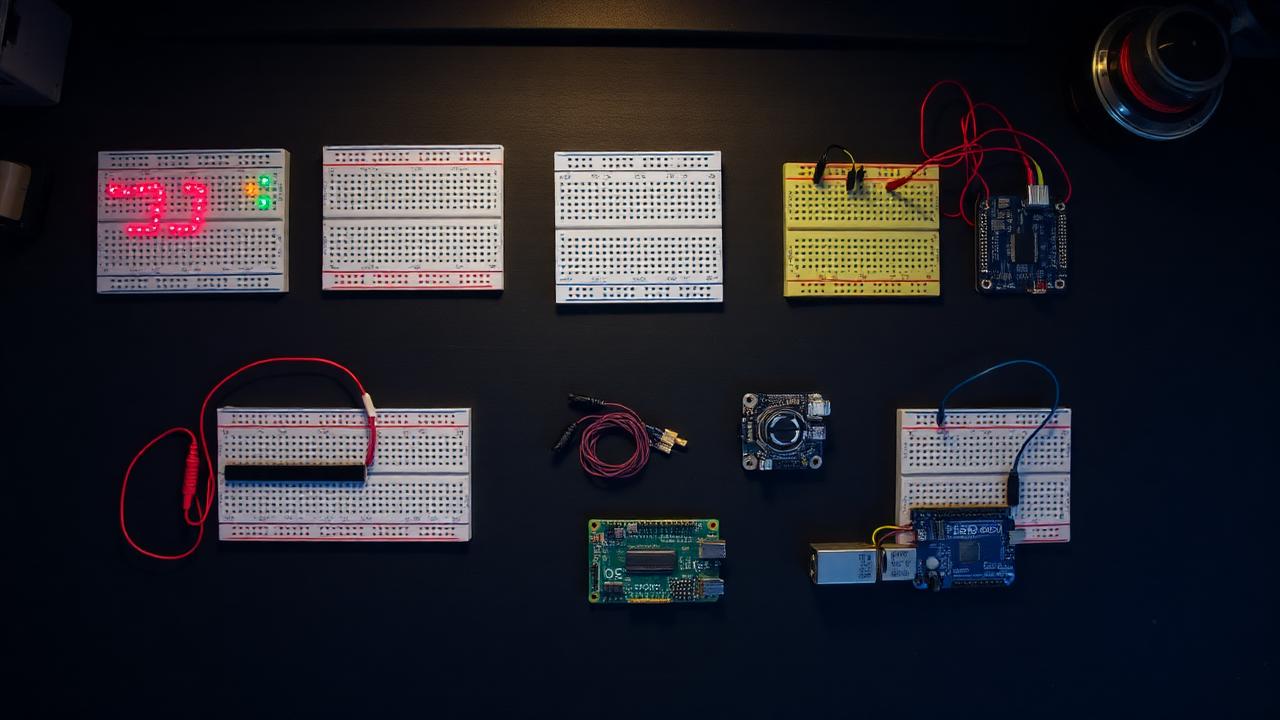
You do not need a lab. A breadboard, a handful of components and a kitchen table cover every project below. They are listed in the order that builds skills fastest — each one reuses what the last one taught you, and all five stay on the breadboard, so nothing here needs soldering.
1. Simple LED circuit
Absolute beginner · under 30 minutes
What you'll learn
Polarity, current limiting and how breadboard rows connect. This is the circuit every other project sits on top of.
Parts
Breadboard, 5 mm LED, 220 Ω resistor, two jumper wires, battery pack or 5 V pin.
2. Traffic light sequencer
Beginner · 1–2 hours
What you'll learn
Driving several outputs from code, timing with delays, and organising wiring so you can still debug it. Your first project with visible behaviour rather than a single state.
Parts
Microcontroller board, red/amber/green LEDs, three 220 Ω resistors, breadboard, jumper wires.
3. Motion alarm
Beginner · 1–2 hours
What you'll learn
Reading a digital sensor, debouncing false triggers, and turning an input into an output. Your first circuit that reacts to the room around it.
Parts
Microcontroller board, PIR motion sensor, piezo buzzer, LED, 220 Ω resistor, jumper wires.
4. Temperature alert system
Beginner+ · 2–3 hours
What you'll learn
Reading analogue or digital sensor data, converting raw values into real units, and acting on a threshold. Also your first taste of calibration.
Parts
Microcontroller board, DHT11 or LM35 temperature sensor, buzzer or LED, 10 kΩ resistor, breadboard.
5. Motor speed controller
Beginner+ · 2–3 hours
What you'll learn
PWM, why motors need their own driver and power supply, and how to read a potentiometer. The bridge from lighting LEDs to moving things.
Parts
Microcontroller board, DC motor, motor driver module, potentiometer, external battery pack, jumper wires.
How to pick one
If you have never wired anything, start at number one and do it today — the confidence matters more than the challenge. If you have already blinked an LED, jump to whichever of the others matches what you find interesting: sensors, sequencing or motion. Buy parts for one project at a time until you know which direction pulls you in.
Not sure which fits your level, time and budget? The CircuitStarter quiz asks five questions and matches you to a specific build, parts list included. And if you are weighing up breadboard prototyping against soldering, read Breadboard vs Soldering before you buy an iron.
Find your match
Five quick questions, one beginner project picked for your experience, time and budget.